






The Bus Has Left, and the Next One Is Practically Tomorrow — How to Organize Trips to Work, Medical Appointments, and Public Offices with Limited Public Transport and Create Local Shared Solutions Without Relying on One Driver for Everything Max Paradox
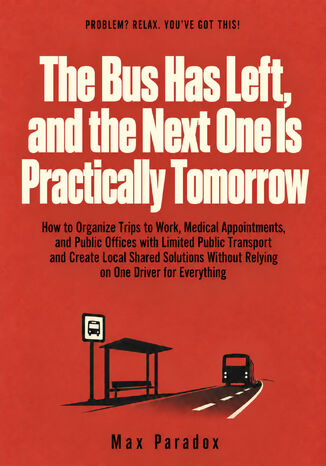
- Autor:
- Max Paradox
- Wydawnictwo:
- self publisher
- Ocena:
- Stron:
- 185
- Dostępne formaty:
-
PDFePub
-
 Publikacja stworzona ze wsparciem AI
Opis
książki
:
The Bus Has Left, and the Next One Is Practically Tomorrow — How to Organize Trips to Work, Medical Appointments, and Public Offices with Limited Public Transport and Create Local Shared Solutions Without Relying on One Driver for Everything
Your appointment is at 10 a.m. The bus arrives at 7:15. The return service leaves at 9:40. Apparently, the transport system expects you to attend your appointment through the power of imagination.
Welcome to life with limited public transport, where a simple journey can require more planning than an international holiday, and one helpful relative can accidentally become the entire family's transport department.
In The Bus Has Left, and the Next One Is Practically Tomorrow, Max Paradox tackles a familiar but frequently overlooked problem: how do you organise work commutes, medical appointments, government office visits, and everyday activities when buses are infrequent, connections are unreliable, and owning a car isn't necessarily an option?
With sharp observational humour and genuinely practical advice, this book helps you take greater control of your journeys without pretending that every problem can be solved by buying a vehicle, moving house, or convincing your neighbour to become a full-time chauffeur.
Discover how to identify the journeys that cause the greatest difficulties, including the opportunities you've stopped considering because transport seems impossible. Learn to evaluate timetables realistically, avoid impossible connections, manage unpredictable return journeys, and recognise when a supposedly nearby bus stop is practically inaccessible.
Explore ways to organise multiple errands into one sensible trip, manage changing work schedules, compare the real costs of different transport options, and respond when a confirmed journey suddenly falls apart.
The book also examines community ride-sharing and local transport cooperation. You'll learn how to discover overlapping journeys, introduce potential passengers and drivers, establish clear expectations, share costs fairly, and create simple coordination arrangements without turning one volunteer into an unpaid dispatch centre.
But cooperation has limits. What happens when everybody needs a ride and nobody can drive? How should a group respond when certain residents cannot use the available vehicles? What if a promising arrangement creates conflicts, becomes unreliable, or places unreasonable pressure on one person?
Max Paradox addresses these complications with realistic examples, practical boundaries, and an understanding that community goodwill cannot replace every missing transport service.
You'll also explore how to approach employers and local authorities with specific transport problems, understand the possibilities and limitations of demand-responsive services, and recognise when professional or institutional support may be necessary.
This is not a book promising that your local bus will suddenly arrive every fifteen minutes. Nor will it teach you to transform a broken bicycle into a functioning minibus using determination and household stationery.
Instead, it offers a more useful goal: greater independence, fewer unnecessary transport emergencies, clearer decisions, and less of your life organised around someone else's car keys.
Ideal for residents of rural communities and smaller towns, commuters with difficult schedules, people without regular access to a car, families coordinating essential journeys, and anyone interested in practical local transport solutions.
Because missing a bus should be an inconvenience, not a verdict on what you can do with your life.
This publication was prepared using tools that support the creative process, including artificial intelligence solutions. The final concept, structure and editing are the responsibility of the author.




Szczegóły książki
- ISBN Ebooka:
- 978-83-848-3836-5, 9788384838365
- Data wydania ebooka :
-
2026-11-04
 Data wydania ebooka często jest dniem wprowadzenia tytułu do sprzedaży i może nie być równoznaczna
z datą wydania książki papierowej. Dodatkowe informacje możesz znaleźć w darmowym fragmencie.
Jeśli masz wątpliwości skontaktuj się z nami [email protected].
- Język publikacji:
- angielski
- Rozmiar pliku Pdf:
- 1.1MB
- Rozmiar pliku ePub:
- 1.5MB
- Pobierz przykładowy rozdział PDF »
- Pobierz przykładowy rozdział EPUB »

Dzięki opcji "Druk na żądanie" do sprzedaży wracają tytuły Grupy Helion, które cieszyły sie dużym zainteresowaniem, a których nakład został wyprzedany.
Dla naszych Czytelników wydrukowaliśmy dodatkową pulę egzemplarzy w technice druku cyfrowego.
Co powinieneś wiedzieć o usłudze "Druk na żądanie":
- usługa obejmuje tylko widoczną poniżej listę tytułów, którą na bieżąco aktualizujemy;
- cena książki może być wyższa od początkowej ceny detalicznej, co jest spowodowane kosztami druku cyfrowego (wyższymi niż koszty tradycyjnego druku offsetowego). Obowiązująca cena jest zawsze podawana na stronie WWW książki;
- zawartość książki wraz z dodatkami (płyta CD, DVD) odpowiada jej pierwotnemu wydaniu i jest w pełni komplementarna;
- usługa nie obejmuje książek w kolorze.
Masz pytanie o konkretny tytuł? Napisz do nas: [email protected]
Książka drukowana


Oceny i opinie klientów: The Bus Has Left, and the Next One Is Practically Tomorrow — How to Organize Trips to Work, Medical Appointments, and Public Offices with Limited Public Transport and Create Local Shared Solutions Without Relying on One Driver for Everything Max Paradox
(0)