






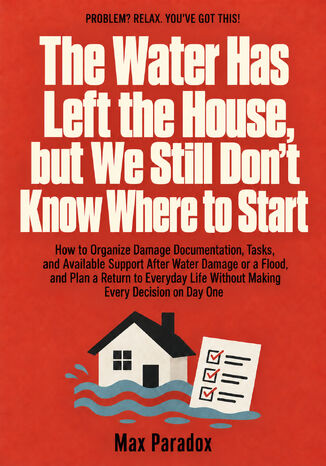
The Water Has Left the House, but We Still Don't Know Where to Start — How to Organize Damage Documentation, Tasks, and Available Support After Water Damage or a Flood, and Plan a Return to Everyday Life Without Making Every Decision on Day One Max Paradox
- Autor:
- Max Paradox
- Wydawnictwo:
- self publisher
- Ocena:
- Stron:
- 194
- Dostępne formaty:
-
PDFePub
-
 Publikacja stworzona ze wsparciem AI
Opis
książki
:
The Water Has Left the House, but We Still Don't Know Where to Start — How to Organize Damage Documentation, Tasks, and Available Support After Water Damage or a Flood, and Plan a Return to Everyday Life Without Making Every Decision on Day One
The water is gone. The furniture is ruined. The paperwork appears to be reproducing. And someone has just asked when you're planning to move back home.
Wonderful question. Perhaps they could ask the walls.
After a flood or serious water damage, the hardest part isn't always the water itself. It's everything that happens afterward. The building needs assessing, damaged belongings need sorting, insurance questions demand answers, contractors have conflicting schedules, and ordinary life continues as though nothing unusual has happened.
Meanwhile, you're expected to make expensive decisions while exhausted, overwhelmed, and increasingly suspicious of every damp-looking surface.
The Water Has Left the House, but We Still Don't Know Where to Start is a practical, witty guide to navigating the complicated aftermath of flooding without trying to solve your entire future before breakfast.
In his characteristic style, Max Paradox combines useful explanations, realistic examples, intelligent humour, and a healthy respect for the fact that disaster recovery rarely follows a convenient timetable.
This book helps you understand how to approach the first assessment of damage, recognise situations requiring qualified professionals, and distinguish genuine emergencies from decisions that can responsibly wait. You'll discover how to organize photographs, receipts, correspondence, and other evidence so that important information doesn't disappear into a phone containing four hundred nearly identical pictures of a damaged wall.
You'll also explore the practical challenges of insurance claims, available assistance, repair quotations, contractor coordination, and unexpected expenses. Because a restoration budget has an unfortunate tendency to become outdated approximately eleven minutes after somebody calls it final.
But recovering a home involves more than buildings and money.
What happens when your family needs temporary accommodation for much longer than expected? How do you accept useful help without turning your driveway into an unofficial donation warehouse? What if relatives disagree about repairs, precious belongings cannot be saved, or a problem reappears after the work supposedly finished?
And what if returning home is no longer the most realistic option?
Across twenty substantial chapters, the book examines these difficult situations with practical insight and humour directed at the absurdities of the process, never at people experiencing genuine hardship.
Rather than promising miraculous solutions, it shows you how to identify what is known, understand what still needs checking, organise responsibilities, ask more useful questions, and make decisions suited to your actual circumstances.
The final chapters address the challenges that continue after renovation: persistent exhaustion, future flood concerns, unfinished administrative obligations, and the gradual return to independent everyday living.
This isn't a book about becoming the world's greatest flood-recovery manager. It's about eventually being able to stop being one.
You won't find a magical formula that makes contractors arrive simultaneously, insurers agree with every estimate, or damaged furniture repair itself out of embarrassment.
You will find a clearer way to approach difficult decisions, avoid unnecessary confusion, and recover some control over a situation that may initially feel impossible to manage.
Because when water has disrupted your home, you deserve more than another person telling you to stay calm.
You deserve to know what actually makes sense to do next.
This publication was prepared using tools that support the creative process, including artificial intelligence solutions. The final concept, structure and editing are the responsibility of the author.




Szczegóły książki
- ISBN Ebooka:
- 978-83-848-3892-1, 9788384838921
- Data wydania ebooka :
-
2026-11-04
 Data wydania ebooka często jest dniem wprowadzenia tytułu do sprzedaży i może nie być równoznaczna
z datą wydania książki papierowej. Dodatkowe informacje możesz znaleźć w darmowym fragmencie.
Jeśli masz wątpliwości skontaktuj się z nami [email protected].
- Język publikacji:
- angielski
- Rozmiar pliku Pdf:
- 1.2MB
- Rozmiar pliku ePub:
- 1.7MB
- Pobierz przykładowy rozdział PDF »
- Pobierz przykładowy rozdział EPUB »

Dzięki opcji "Druk na żądanie" do sprzedaży wracają tytuły Grupy Helion, które cieszyły sie dużym zainteresowaniem, a których nakład został wyprzedany.
Dla naszych Czytelników wydrukowaliśmy dodatkową pulę egzemplarzy w technice druku cyfrowego.
Co powinieneś wiedzieć o usłudze "Druk na żądanie":
- usługa obejmuje tylko widoczną poniżej listę tytułów, którą na bieżąco aktualizujemy;
- cena książki może być wyższa od początkowej ceny detalicznej, co jest spowodowane kosztami druku cyfrowego (wyższymi niż koszty tradycyjnego druku offsetowego). Obowiązująca cena jest zawsze podawana na stronie WWW książki;
- zawartość książki wraz z dodatkami (płyta CD, DVD) odpowiada jej pierwotnemu wydaniu i jest w pełni komplementarna;
- usługa nie obejmuje książek w kolorze.
Masz pytanie o konkretny tytuł? Napisz do nas: [email protected]
Książka drukowana


Oceny i opinie klientów: The Water Has Left the House, but We Still Don't Know Where to Start — How to Organize Damage Documentation, Tasks, and Available Support After Water Damage or a Flood, and Plan a Return to Everyday Life Without Making Every Decision on Day One Max Paradox
(0)